
Hot Wallet vs Cold Wallet: Where Your Crypto Is Safest in 2026
A hot wallet is online and quick, a cold wallet keeps your keys offline. Here is which to use for what, and how the biggest thefts of 2024 and 2025 really happened.

Key takeaways
- Hot wallets keep your keys on an online piece of equipment. These are suited to small and frequent transfers as they are very user friendly.
- Cold wallets keep your keys offline, typically on a small bit of physical equipment. Cold wallets can help protect from malware getting onto your phone or computer with access to your keys.
- Cold wallets can be attacked though. Over the last two years some of the biggest attacks have been due to social engineering causing the wrong transaction to be confirmed.
- Typically both a cold and hot wallet are ideal for most users. A hot wallet can be used for everyday transactions and a cold wallet is ideal for long term storage.
When using crypto the first question all users ask is in which format should my crypto be kept; inside an app on my mobile or in a separate wallet in my desk drawer? This also depends on the volume of crypto I hold and how often I transfer crypto.
What is a hot wallet?
A hot wallet is a wallet that keeps your private keys on an internet connected device. This can be a browser extension, desktop wallet or app on a mobile phone. Crypto held on an exchange is slightly different as the exchange holds the private keys rather than the user.
What it does well
- Set up free and up and running in minutes
- Fast for swaps, payments and exchanges
- Easy backup via seed phrase
Where it is weak
- Susceptible to malware and fake apps on the same device
- Easy to lose funds with one click on a phishing site
What is a cold wallet?
Cold wallet means the keys are stored on offline devices (not on the internet). A common form of this is a hardware wallet. A hardware wallet is small and can sign transactions. Another form of a cold wallet is a paper or metal seed phrase.
What it does well
- Keys are safe and not affected by malware
- Transaction requires action on the device
- Good for saving not often used
Where it is weak
- More expensive and slower to use
- Losing device and backup also means losing funds
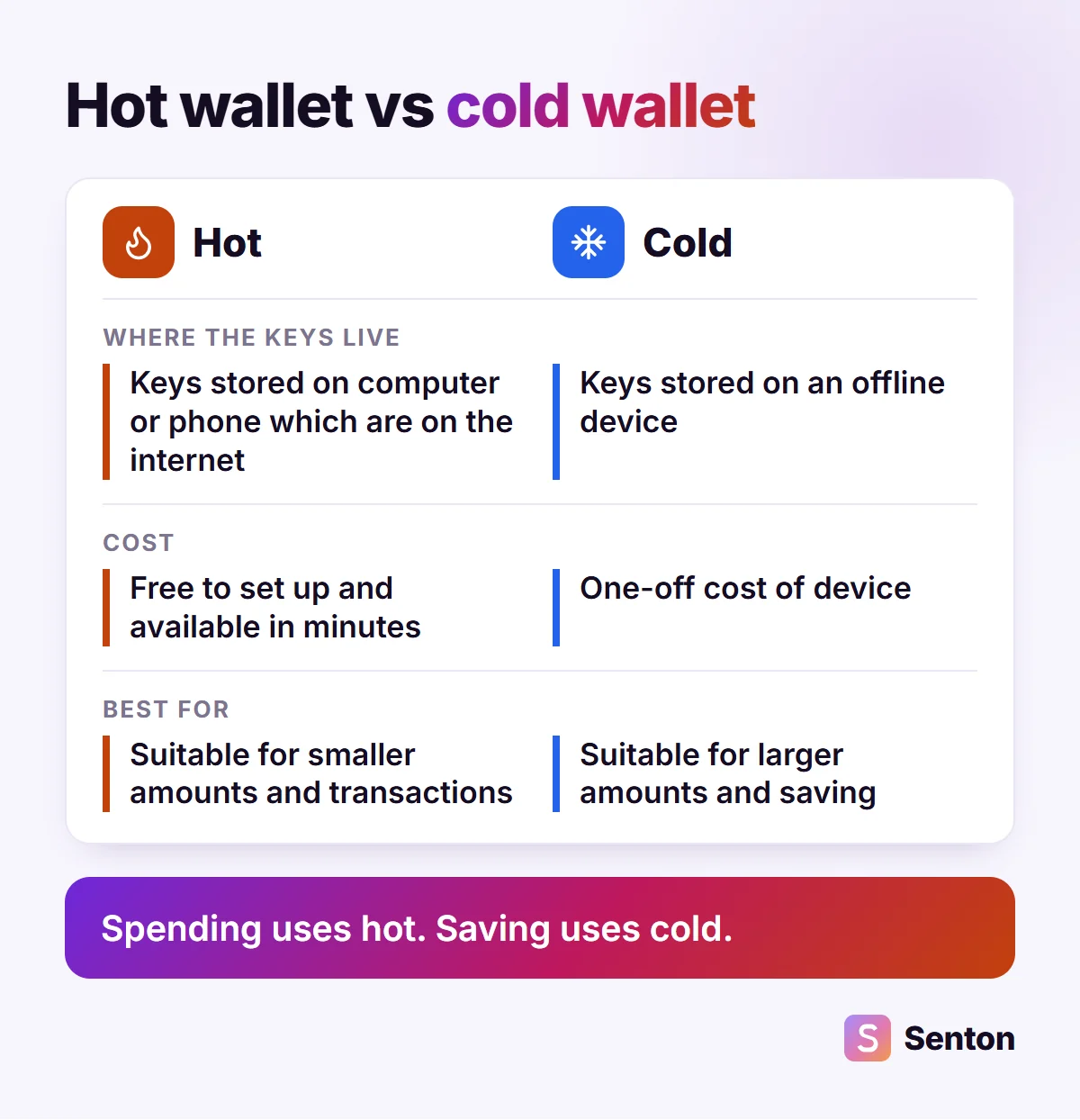
Hot wallet vs cold wallet at a glance
Comparison using the most important factors for deciding which to use
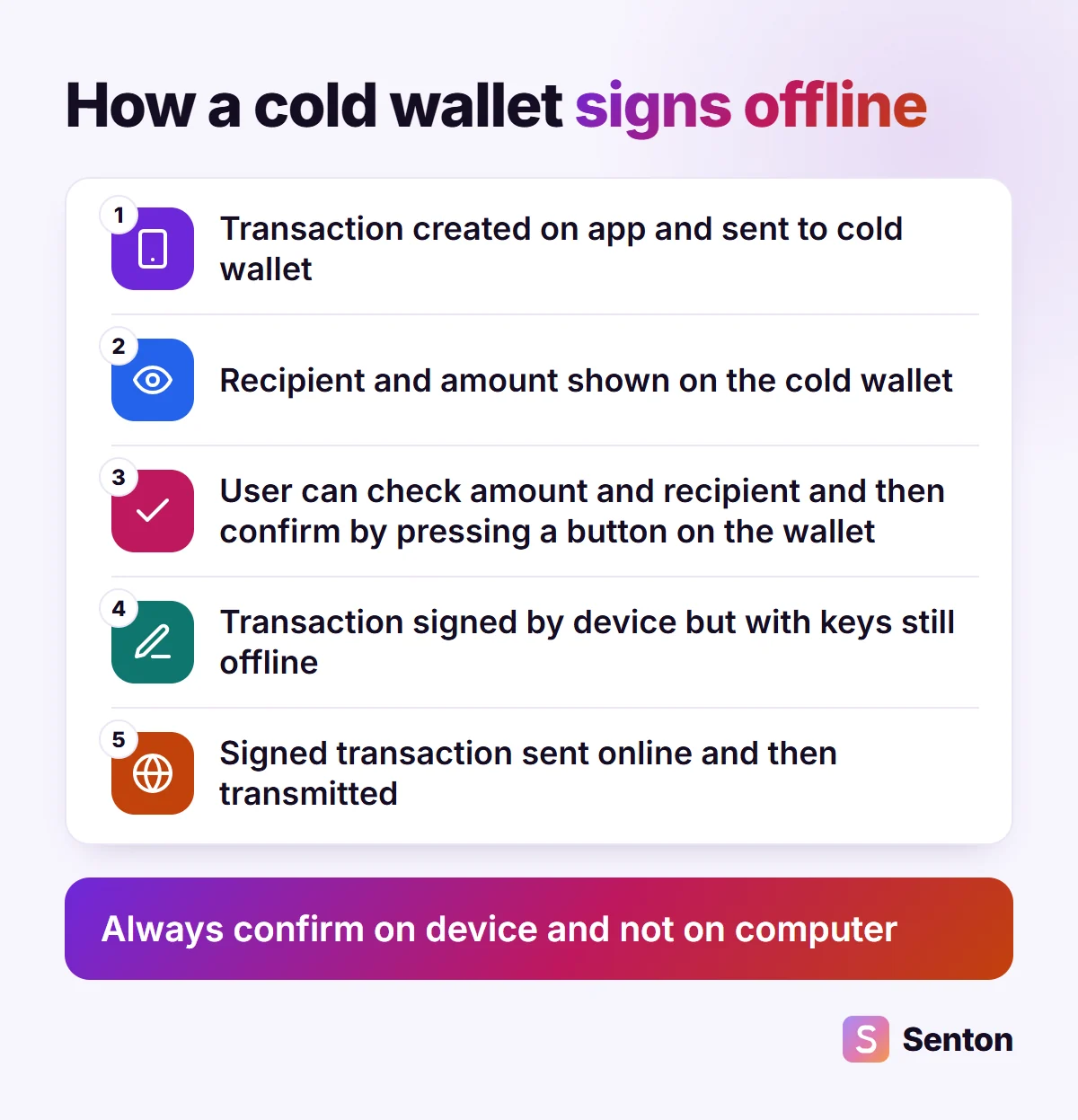
How a cold wallet signs offline
The benefit of a cold wallet is they can still be used to send crypto whilst keeping the keys offline from the internet. A transaction can be created on an existing device (computer or phone) and then signed by a cold wallet.
Is a hot wallet safe?
A hot wallet can be suitable for everyday smaller amounts but it is essential that the hot wallet/device itself is kept safe. There are many ways users can lose funds to a hot wallet.
-
Fake pages
User is prompted to enter seed/ connection on a page from exchange or wallet
-
Fake apps
Fake app of a real wallet is found in an ad or app store and keys created within an app are stolen
-
Address swapping malware
Malware can intercept user entered address and replace it with an address of choice to an attacker
-
Approving a website
User is prompted to allow transfer of their tokens to a website and they do so

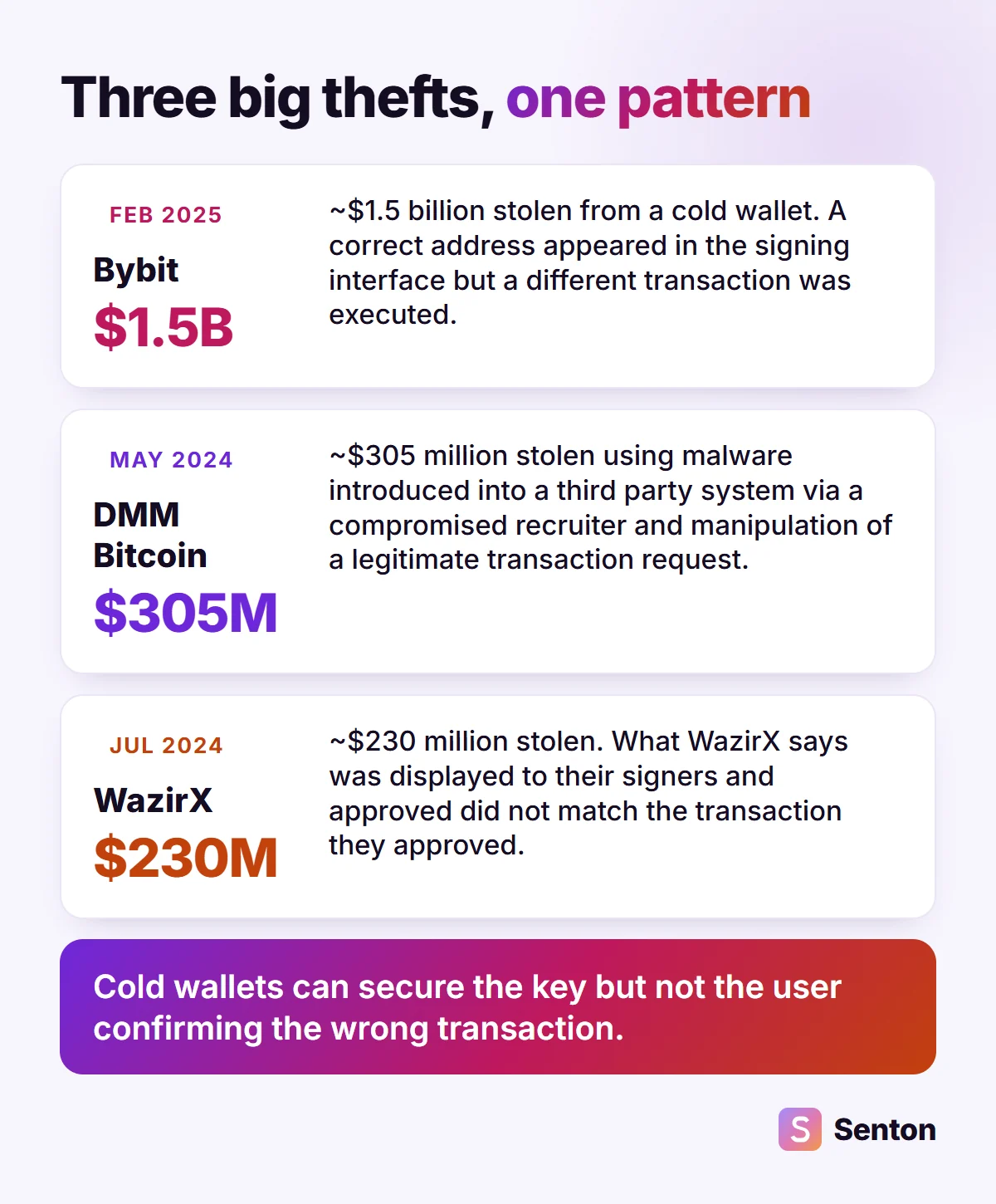
Is a cold wallet hack-proof?
However this isn't the case. In 2024 and into 2025 there have been three of the largest crypto thefts. All these attacks involved higher security services within a company and in none of these cases was encryption avoided. These attacks involved a change to a transaction and user confirmation of this.
Custodial vs non-custodial wallets
There is another question behind the hot vs cold question. Who owns the keys. In a custodial wallet the company owns the keys and the user owns a login. In a non-custodial wallet the user owns the keys.
- Custodial: Funds can be restored using password reset
- Custodial: Company can freeze, limit or lose the funds
- Non-custodial: Only the user has control over the funds
- Non-custodial: No assistance is available if the seed phrase is lost
What is cold storage in crypto?
If an exchange states that a large amount of user crypto is held in cold wallets then this basically means that the user has stored a large amount of their crypto offline and only a small amount is held in a hot wallet for their use. This is safe for the exchange however the user has only the guarantee of their balance from the exchange and not their own crypto.
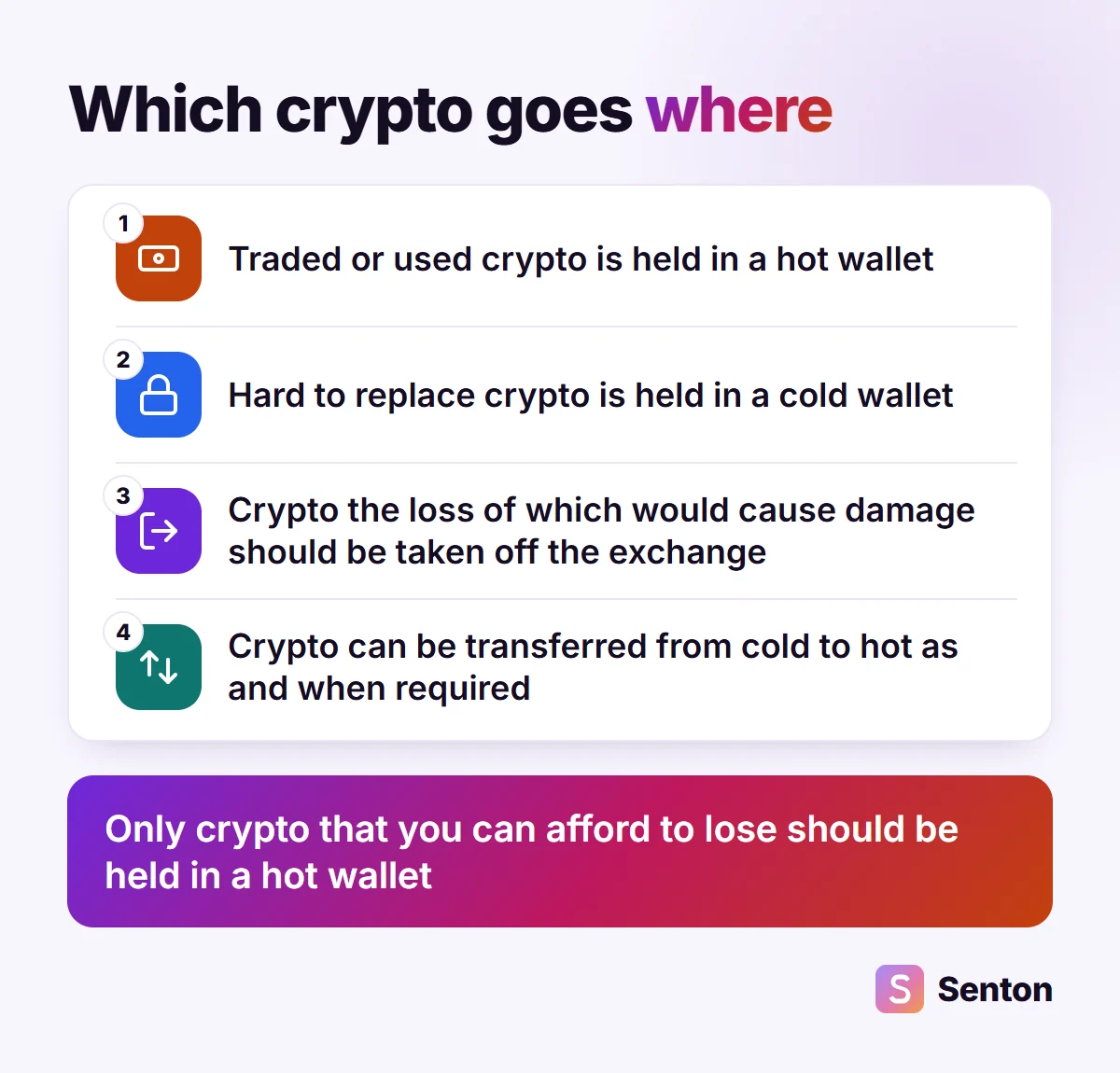
Which should you use?
Crypto can be split depending on its purpose. In the same way that cash can be held in a bank account and some in your pocket.
How to move your savings to a cold wallet
Putting crypto into a cold wallet takes about a night. A safe way to do this could look something like the following.
-
 Purchase a device from manufacturer
Order the device from the manufacturer and check the seal is unbroken. A used device could have been tampered with.
-
 Set up the device and backup the seed
Use the device to create a new seed and backup this to paper or metal. Do not use a seed provided to you.
-
 Transfer a small amount of crypto
 and verify the address on the device has received the crypto prior to transferring the remainder.
-
 Store the device and seed separately
Store the device in one location and the seed in another. This is useful in the case of fire or break in as it ensures both will not be stolen.
Hot and cold wallet myths
-
Myth
Cold wallets are not hackableFactThe key is difficult to steal but a user may be duped into approving a fraudulent transaction
-
Myth
I store my crypto in a hardware walletFactMy crypto exists on the blockchain but the keys within my hardware wallet permit spending
-
Myth
If my hardware wallet is lost then my crypto is also lostFactIf a seed phrase is kept this can be used to restore the wallet on another device
-
Myth
An exchange account is also a walletFactThe keys are held by the exchange however you hold a balance that the exchange owes you and a login
Where Senton Wallet fits
Senton Wallet is on our roadmap but is not currently available. We are planning to create a self-custody hot wallet. In this implementation the user has control of their keys. The keys are generated and stored on the user's device and not by us.
The bottom line
- Hot wallet - for small amounts spent often
- Cold wallet - for savings that would be hard to replace
- Check the amount and address shown on the wallet before any transaction is approved
- Do not input your seed phrase into a website and keep your seed phrase offline
Frequently asked questions
Yes for small amounts, as long as the computer or phone is secure and only download wallets from official sources. Larger amounts of crypto should be stored in a cold wallet.
Taking a cold wallets key off the device is difficult. Losses more commonly occur through a user giving away their seed phrase or being duped into approving a transaction.
Not for small amounts. Once you own more than you would be comfortable losing a cold wallet makes sense.
If you have a seed phrase then your crypto is safe. You can restore your crypto to a new device using the seed phrase. The wallet will also be restored.
Yes. This is commonly used by users. A hot wallet can be used for day to day transactions and the remainder can be moved to a cold wallet.
The most prevalent type of cold wallet is a hardware wallet. A software wallet is one that is an app either on a mobile or desktop device. These are classed as a hot wallet.