
WireGuard vs OpenVPN: Which VPN Protocol Is Faster and Safer in 2026?
WireGuard is faster and simpler, OpenVPN can run over TCP. Here is how they compare on speed, security and privacy, and why both can be blocked.

Key takeaways
- WireGuard is the newer protocol. WireGuard is fast to connect and has a small footprint. It only works over UDP.
- OpenVPN has been available since 2001. OpenVPN is slower to connect but can work over TCP which can be useful over restricted networks.
- Both protocols use very modern and strong encryption. Both reveal that they are a VPN. Plain OpenVPN and plain WireGuard can be detected and blocked.
- For the average user on a phone or a laptop WireGuard is usually the better choice.
Most VPN apps have a protocol setting in the app settings. There are usually two protocol names listed. Whilst the protocol has a technical aspect it does affect blockability, network switching and connection speed.
What is WireGuard?
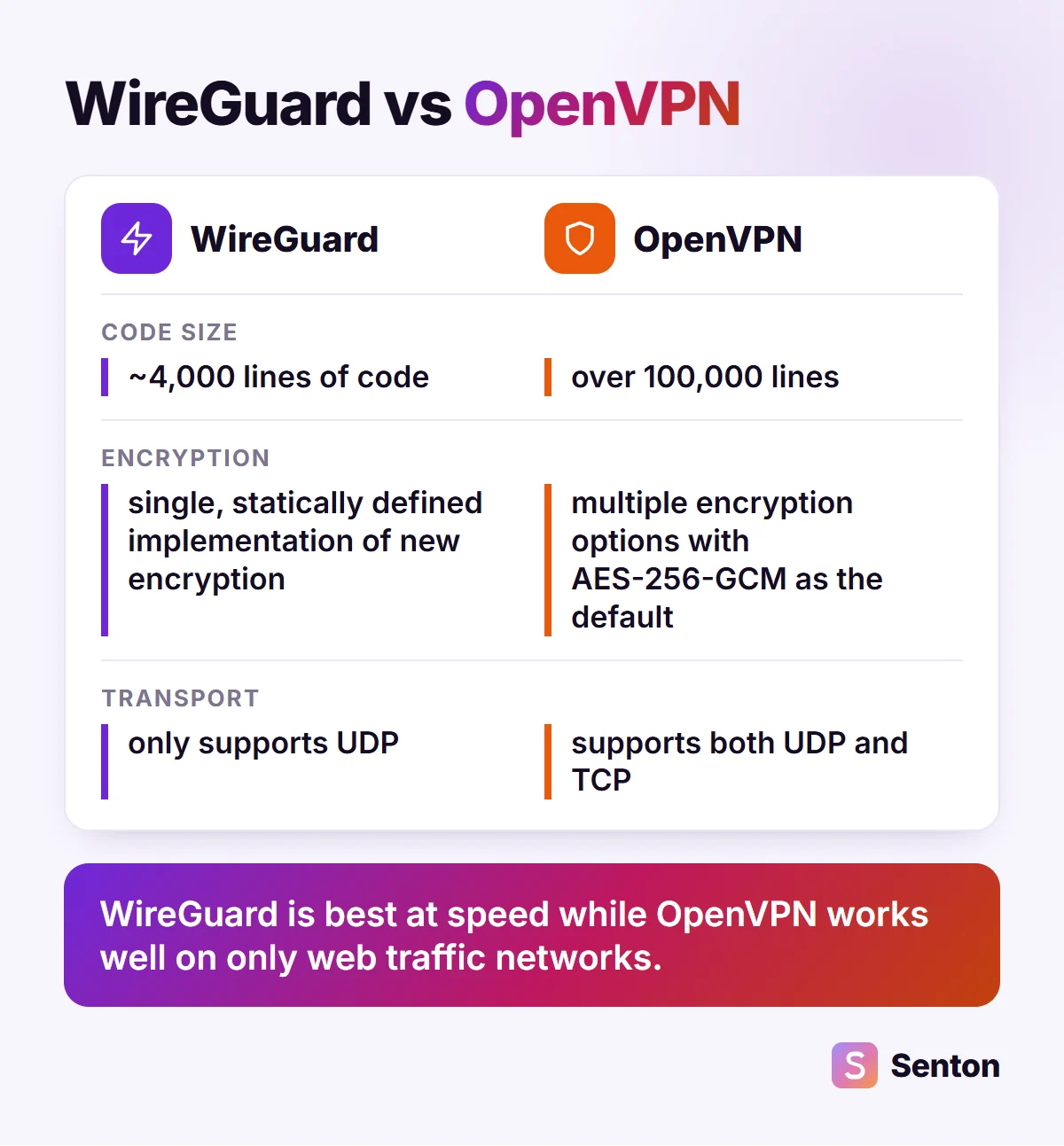
WireGuard is a modern VPN protocol. It uses a small number of modern encryption methods and has no configurable options that can be set incorrectly. WireGuard was introduced to the Linux kernel in March 2020. The code is typically stated to be around 4000 lines and readable by one person.
What it does well
- Fast network switch from Wi-Fi to mobile data
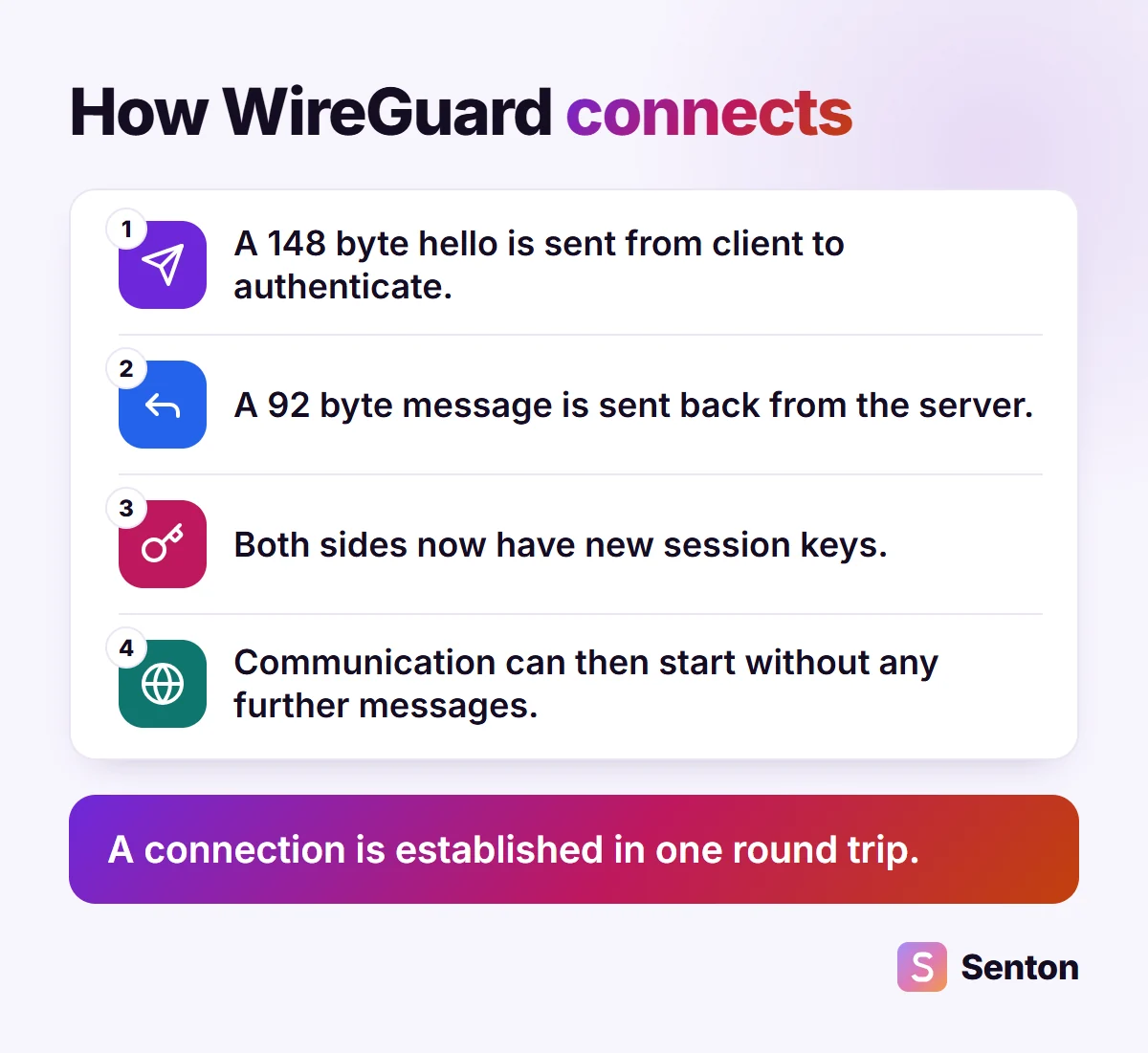
- Fast connection with only one round trip
- Smaller footprint and easier to examine
Where it falls short
- Only supports UDP (no support for TCP)
- Does not attempt to mask the fact that it is a VPN
What is OpenVPN?
The chosen protocol is OpenVPN. OpenVPN was first released in 2001. It uses the same secure website technology (TLS) and supports both TCP and UDP. It also has a typical implementation with over 100,000 lines of code and a number of different configuration parameters.
What it does well
- Supports TCP on the same port that is used by websites
- Supported on a huge variety of platforms including routers and legacy systems
- Publicly reviewed for 20 years
Where it falls short
- Relatively slow connection time
- Supports a large number of configuration parameters which can be misconfigured fairly easily
WireGuard vs OpenVPN at a glance
Below is a table of comparison of the two protocols using parameters relevant to a user deciding what protocol to use.
Is WireGuard faster than OpenVPN?
There are generally two reasons WireGuard tends to appear faster. Firstly there are only two very short messages used when establishing a connection. Secondly the protocol itself is relatively small and simple. This translates into less computation per packet. There are also only an additional 32 bytes per packet. On Linux WireGuard is built into the operating system, on all other platforms it is usually a standard application. As a result perceived speed will also vary depending on the platform.
OpenVPN has closed some of this gap. Since January 2023 OpenVPN 2.6 has added support for running the data path within the operating system. In reality in practice, the distance to the chosen server and the server that is chosen are typically more significant factors than the protocol used.
Is WireGuard more secure than OpenVPN?
Both can be used securely. However there is the possibility of a misconfiguration. WireGuard uses a known set of current and well examined encryption algorithms, and there is no weak algorithm that can be accidentally enabled. OpenVPN since recent versions has defaulted to either AES-256-GCM or ChaCha20-Poly1305. However misconfigurations can occur with older versions.
The key difference between the two however is complexity. The smaller code base is in theory easier to examine completely. The larger code base has also been in use for a number of years. Neither however can completely prevent negligence from an organisation.
Is WireGuard good for privacy?
One problem that has come up with WireGuard is that when using a WireGuard server it stores the last IP address used by a client whilst connected to the server. This allows the server to reply to the client. This information can be viewed using the status command on the server. The length of time that this data is stored and if it is ever written to disk is up to the organisation and not the protocol.
Can WireGuard or OpenVPN be blocked?
Neither of these protocols were created with stealth in mind. At a conference called USENIX Security in 2022 a research team presented a study of a internet service provider with around a million users. The study found in excess of 85% of OpenVPN sessions were detected with a very low number of false positives. 34 of the 41 VPN services that were advertised as covert were also detected.
WireGuard detection is not any more difficult. WireGuard itself does not aim to be obfuscated. The first packet in a WireGuard session is also of a known size. As a result plain WireGuard and plain OpenVPN are often the first to be blocked in a VPN blacklisting attempt. In February 2024 Iran blocked the use of unauthorised VPN services.
What our search data from Iran and Turkmenistan shows
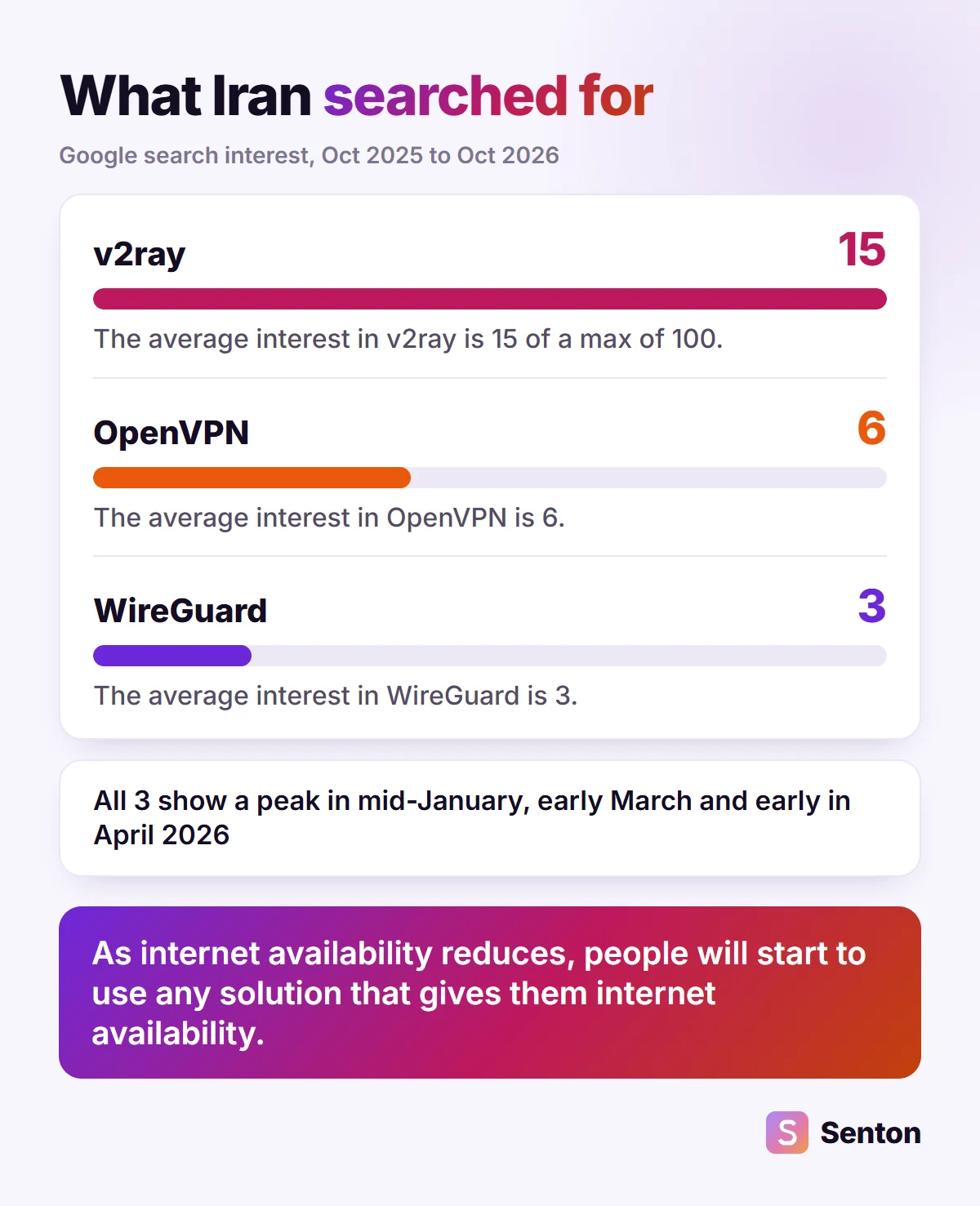
There is data available for 3 tunnel types in Iran with Google search interest. The interest in v2ray (which mimics normal internet usage) is higher than the interest in OpenVPN, and the interest in OpenVPN is around double that of the interest in WireGuard.
In Turkmenistan there also appears to be a similar pattern. For Russian queries in Turkmenistan the interest in both WireGuard and OpenVPN has averaged around 320 searches per month for the last year. Both also show a reduction from the end of 2025.
Where you will notice the difference
The active tunnel is usually not visible to the end user but it is in such cases that visibility is required.
-
 Leaving the house mid call
When switching from a home internet connection to mobile data on a mobile phone WireGuard offers a smooth handover as there is no handshake required.
-
 Opening the laptop at a cafe
With a single round trip connection the VPN will be established before the first page is loaded.
-
 Working from a strict office network
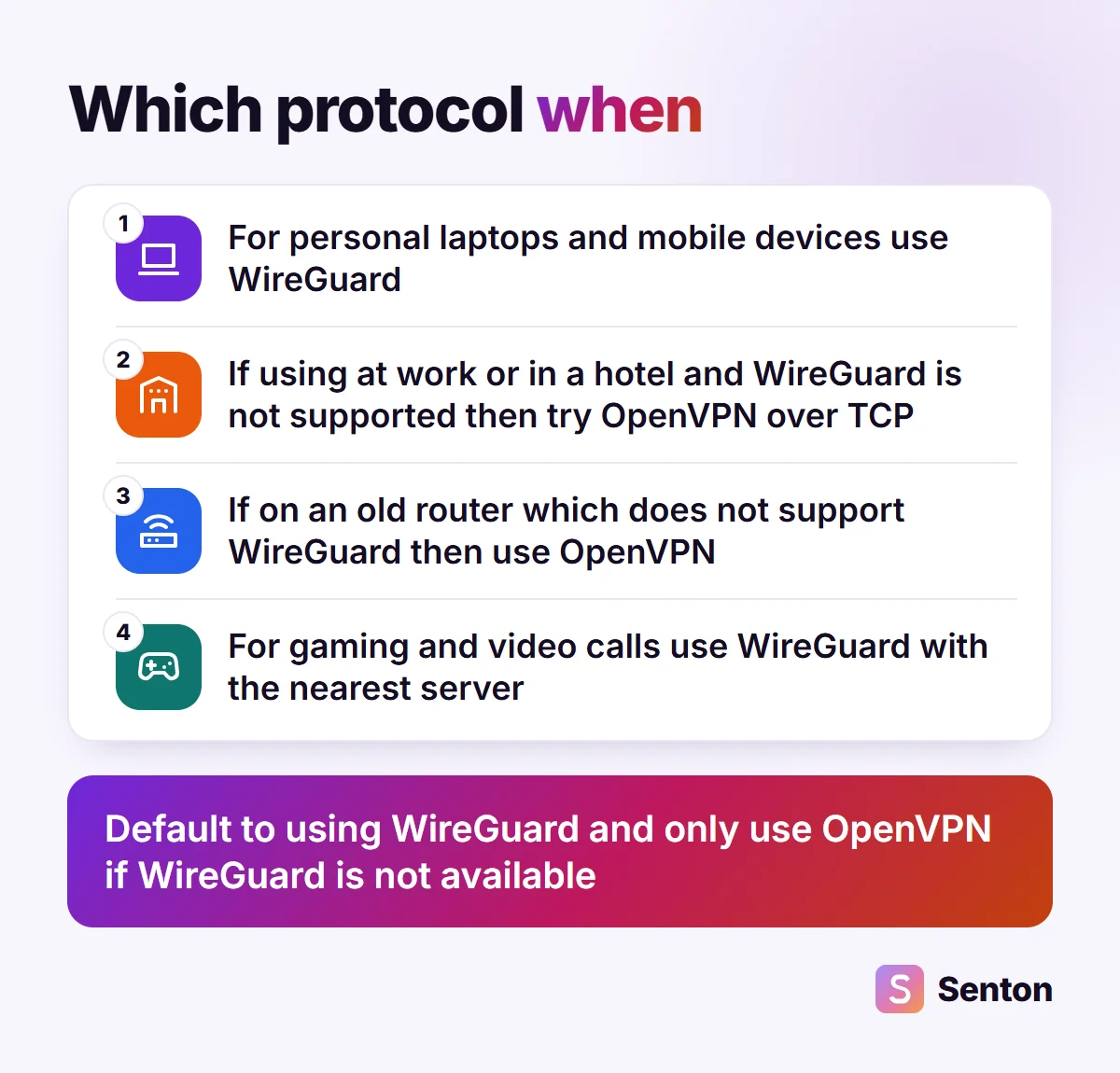
Some networks may only permit out-bound internet usage. OpenVPN over TCP may be the only solution that can pass through such a network as UDP based solutions will not.
-
 Travelling somewhere VPNs are restricted
In some countries plain tunnels may also be blocked. Before travelling check the local laws as a VPN will not impact these.
Which VPN protocol should you use?
If in doubt use the default tunnel and only switch if a particular tunnel does not work.
WireGuard and OpenVPN myths
-
Myth
WireGuard is less secure because it is new.FactWireGuard uses modern encryption that has been well studied and is also relatively small and easier to audit.
-
Myth
OpenVPN is always slow.FactIf connected to a server over a stable connection there may not be a perceivable speed difference. The performance of new OpenVPN clients has also increased.
-
Myth
Using OpenVPN over TCP hides that you use a VPN.FactOpenVPN can be detected. In a study the majority of OpenVPN connections were detected at an actual internet service provider.
Why Senton VPN uses WireGuard
Senton uses WireGuard as it works over varying connections and is faster for general use on mobiles and laptops. A Kill Switch is used to prevent data leaking should the connection drop and there is also a no-logs policy.
The bottom line
- WireGuard is faster and simpler for the majority of users.
- If a network only supports TCP then OpenVPN can be used as a fallback.
- Both can be safe if used correctly and also the VPN service itself makes a difference.
- Neither hides the fact that a VPN is being used on a censorship enabled network.
Frequently asked questions
Generally yes. A connection only requires one round trip and there is less computation per packet due to the small size of the protocol. Perceived speed will also vary depending on the device used. Often a user's distance to the remote server and their level of internet connection are more significant factors than the protocol itself.
Both can be safe if used correctly. OpenVPN is more flexible but older OpenVPN connections are more likely to be used incorrectly. WireGuard only uses one modern encryption method.
No. WireGuard only works over UDP. The protocol also suggests using a different application when wrapped over TCP.
Yes. Over 85% of OpenVPN connections were detected at an actual internet service provider in a 2022 study. A large number of OpenVPN connections claiming to be hidden by VPN services were also detected.
Yes it can. When you are connected your last IP address is saved on the server and used to respond to your requests. The issue is whether this information is saved or is logged by the provider.
Senton uses a Kill Switch, no-logs policy and WireGuard.